Skip to content

How to navigate a difficult conversation is one of the most searched leadership questions in the workplace, and one of the least confidently answered. Most leaders know these conversations need to happen, but they either avoid them or walk in without a clear structure, which is why they so often go sideways.
The truth is, difficult conversations don’t get easier with time. They get easier with a repeatable framework you can lean on no matter who’s sitting across the table.
Below you’ll find a general navigation framework for any difficult conversation, followed by specific templates for four of the most common situations HR leaders and managers face.
The 4 Steps for Navigating Any Difficult Conversation
Before you walk into a specific scenario, every hard conversation follows the same four-step arc. Master this and you’ll know how to navigate the moment even when the situation is unfamiliar.
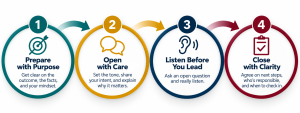
Step 1: Prepare with Purpose
Get clear on the outcome you want, the facts that support it, and the emotional state you’re bringing into the room. If you can’t say what “good” looks like on the other side of this conversation, you’re not ready to have it yet.
Step 2: Open with Care
Set the tone in the first 30 seconds. Name what you’re there to discuss, why it matters, and what your intent is, so the other person isn’t guessing whether they’re in trouble or being invited into a real dialogue.
Step 3: Listen Before You Lead
Ask an open question and then actually listen to the answer, without formulating your response while they’re talking. What you hear in that moment will shape whether this becomes a productive conversation or a monologue you delivered.
Step 4: Close with Clarity
End with a shared understanding of what happens next, who’s responsible for what, and when you’ll check in again. A hard conversation without a clear next step is a hard conversation you’ll have again next month.
Now let’s walk through how these four steps play out in four of the most common difficult conversations leaders face.
Scenario 1: The Toxic Culture Disruptor
This is the person whose behavior is quietly eroding the team, and everyone is waiting for someone to say something. Avoiding this conversation costs you culture, retention, and your credibility as a leader.
Template:
“Thanks for making time. I want to talk with you about some patterns I’ve been noticing that are impacting the team. When [specific behavior] happens in [specific setting], the effect is [specific impact], and I need that to change. I know you may not have seen it this way, so I want to hear your perspective, and then we’ll agree on what shifts from here.”
Scenario 2: The Employee Falling Behind
This one gets harder the longer you wait. The instinct is to lecture or document, but the best version of this conversation opens with curiosity, not correction.
Template:
“Thanks for coming in. I want you to know this isn’t a performance conversation, it’s a check-in, because I’ve noticed some things and I’d like to understand what’s going on. I know this isn’t the work you’re capable of, so talk to me. What’s getting in the way?”

Scenario 3: The Peer Who Became Your Direct Report
You were friends. Then you got promoted. Now you have to lead them, and the friendship dynamic that made you close is the exact thing that makes accountability feel impossible.
Template:
“I want to talk about something I’ve been sitting with since I stepped into this role. Our friendship means a lot to me, and it’s also making it hard to give you the same clarity I owe every person on the team. I need us to agree on how we handle work conversations differently now, so I can lead you well and we can both protect what we’ve built.”
Scenario 4: The High Performer with a Behavioral Issue
This is the one leaders avoid most, because they don’t want to lose the person. But great leaders know that unaddressed behavior from a top performer teaches the whole team what your real standards are.
Template:
“Your work is exceptional, and I want to be direct with you because you’ve earned that. Something is showing up in how you interact with the team that’s affecting the culture we’re trying to build. I want to name it, hear your take, and figure out together how we protect both your growth here and the team dynamic.”
Final Thoughts
Difficult conversations are one of the most important skills any leader can build, because they touch every part of team performance, culture, and retention. Master the four-step framework, adapt it to the situation in front of you, and you’ll find that the conversations you used to dread become the conversations that move your team forward.
If you want to build these skills deeper across your leadership team, our Art of Active Listening course teaches the foundational listening skills that make every difficult conversation land better. Enroll here: learn2engage-marketplace.newzenler.com/courses/the-art-of-active-listening