

Employees are taking development into their own hands. Here’s what that means for your bottom line in 2026.
Something unusual is happening in workplaces across the country, and it hasn’t stopped. Employees are still spending evenings and weekends developing skills their companies desperately need. They’re taking LinkedIn Learning courses at midnight, joining Toastmasters on Saturday mornings, and enrolling in communication workshops on their own.
The numbers from 2025 told a stark story that remains true today. According to LinkedIn’s 2025 Workplace Learning Report, 91% of learning and development professionals agree continuous learning is more important than ever for career success. Yet nearly half (49%) admit their executives are concerned employees don’t have the right skills to execute business strategy.
Fast forward to 2026, and this disconnect hasn’t improved. If anything, it’s widened. And it’s costing companies more than they realize.
The Soft Skills Gap Is Getting Wider

While technical skills, such as AI, get all the attention, soft skills are becoming the true differentiator between companies that thrive and those that merely survive.
Research from Harvard Business Review reveals that foundational skills like collaboration, adaptability, and critical thinking now matter more than specialized technical knowledge for long-term career success.
LinkedIn’s platform data backs this up, showing that professionals with strong soft skills earn promotions 11% faster than their peers.
But here’s the kicker: 92% of talent professionals say soft skills are as important as hard skills in hiring decisions, yet many organizations still treat soft skills development as a nice-to-have rather than a strategic imperative.
The Real Cost of Doing Nothing
When companies neglect soft skills training, they don’t just lose productivity. They lose people. And those people take critical institutional knowledge with them.
LinkedIn analyzed millions of employee transitions and identified the skills most likely to be depleted when talented employees leave. The top skill lost? Business strategy, the ability to set goals and adjust to market forces. Other at-risk skills include strategic planning, sales management, and project planning.
These aren’t skills you can replace with a quick hire. They require critical thinking, working with uncertainty, and deep institutional knowledge. When these skills walk out the door, companies scramble to rebuild what took years to develop.
Even more concerning, 88% of organizations worry about employee retention, yet many still aren’t connecting the dots. Providing learning opportunities is the number one retention strategy according to survey respondents, but the execution often falls short.
Five Soft Skills Still Driving Business Results in 2026
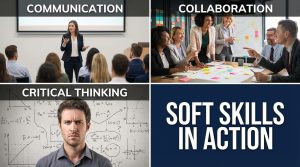
Not all soft skills are created equal. Based on recent workplace trends and performance data, here are the five capabilities every organization should prioritize right now:
- Adaptability and Flexibility
The ability to pivot when circumstances change has moved from valuable to essential, and 2026 is proving this even more true. Companies that scored high on LinkedIn’s Career Development Index, which measures how well organizations support employee growth, showed significantly higher rates of adaptability among their teams.
Organizations with adaptable employees weather market disruptions better, implement new technologies faster, and maintain productivity during change. The challenge? Recent data shows only 36% of organizations qualify as “career development champions” with robust programs that build this capability. That gap is an opportunity for forward-thinking leaders.
- Critical Thinking and Problem-Solving
As AI handles routine tasks, human problem-solving becomes the irreplaceable asset. The World Economic Forum identifies analytical thinking and complex problem-solving among the most in-demand skills for the future.
Employees who can question assumptions, analyze information objectively, and devise effective solutions drive innovation and strategic planning. These are the people who see opportunities others miss and turn challenges into competitive advantages.
- Communication Skills
Clear, effective communication remains the cornerstone of teamwork and leadership. Over 70% of employers place high value on communication abilities, yet many teams struggle with basic information sharing.
In hybrid and remote work environments, the stakes are even higher. Miscommunication costs time, damages relationships, and derails projects. Organizations that invest in communication training see measurable improvements in team productivity, with some studies showing increases of 20 to 25%.
- Emotional Intelligence
Daniel Goleman’s research shows that workers with high emotional intelligence drive significant performance gains. Teams with strong collective EQ perform substantially better than those without it.
Emotional intelligence encompasses self-awareness, empathy, and the ability to manage relationships effectively. In 2025’s collaborative work environments, these capabilities determine who advances into leadership and who stays stuck.
- Leadership at All Levels
You don’t need a manager title to demonstrate leadership. Organizations increasingly value employees who can inspire others, take initiative, and guide projects to success.
In fact, 58% of hiring managers look for leadership potential even in entry-level candidates.
LinkedIn data shows that organizations scoring high on their Career Development Index have higher promotion rates into leadership positions, creating a healthy pipeline of people with both institutional knowledge and strategic thinking.
The Career Development Connection

Here’s where it gets interesting. Organizations that treat soft skills development as part of broader career growth initiatives see dramatically better outcomes than those that offer standalone training.
LinkedIn’s research identified “career development champions” organizations with mature career development programs that include learning, coaching, internal mobility, and leadership opportunities. These champions are 42% more likely to be frontrunners in generative AI adoption compared to other organizations.
They also report:
- Higher confidence in profitability
- Better ability to attract and retain talent
- 63% of employees who received soft skills training improved job performance
- Teams with higher engagement in learning initiatives
The pattern is clear: when employees see how skills development connects to their career progress, they engage more deeply and apply what they learn more effectively.
What High-Performing Organizations Do Differently

Career development champions don’t just offer more training. They build systems that make learning integral to how work gets done.
They provide dedicated time for skill-building, not just access to courses. They train managers to have meaningful development conversations, not just annual reviews. They create career paths that show employees exactly which skills lead to advancement.
Most importantly, they measure what matters. Instead of just tracking course completions, they connect learning investments to business outcomes like productivity, innovation, and revenue growth.
The Skills Employees Are Building On Their Own
While organizations focus on other priorities, employees aren’t waiting around. They’re taking matters into their own hands.
According to LinkedIn platform data, learning and development professionals themselves have been rapidly adding skills like project management, change management, and strategic planning to their profiles. These professionals understand firsthand what’s needed and they’re seeking it wherever they can find it.
The question for business leaders: Would you rather your employees develop critical soft skills through your structured programs where learning aligns with company strategy, or through scattered external courses that may or may not address your specific needs?

The Path Forward
Organizations serious about building competitive advantage in 2025 need to approach soft skills development strategically.
Start by identifying which soft skills directly impact your business goals. Is it collaboration for cross-functional projects? Communication for client relationships? Critical thinking for innovation initiatives?
Next, connect skills development to career progression. Employees need to see the path from where they are to where they want to be, and understand which capabilities will get them there.
Then, give people real opportunities to practice and apply new skills. Leadership development shouldn’t be theoretical. Communication training shouldn’t stay in the classroom. Make skill-building part of daily work through stretch assignments, cross-functional projects, and mentoring relationships.
Finally, measure the impact. Track how soft skills development affects retention, promotion rates, project success, and ultimately revenue. When you can show executives the ROI of learning investments, you’ll find it much easier to secure the resources your programs need.
What’s At Stake in 2026 and Beyond
The soft skills gap isn’t just a training issue. It’s a strategic vulnerability that affects your ability to execute, innovate, and compete. And as we move deeper into 2026, the organizations that recognized this early are already pulling ahead.
Companies that continue to view soft skills as peripheral will watch their best talent leave for organizations that invest in their growth. They’ll struggle to adapt when markets shift. They’ll fall behind as competitors build more agile, emotionally intelligent teams.
The good news? This is still fixable. Organizations that commit to strategic soft skills development now will build workforces capable of navigating whatever challenges the next few years bring.
The question is whether you’ll lead that change or play catch-up while your employees develop critical skills on their own time, preparing for opportunities at companies that will value what they bring.
Building Your Soft Skills Strategy
If you’re ready to close the soft skills gap in your organization, the path is clearer than you might think.
At Learn2Engage, we’ve helped businesses across industries develop custom learning solutions that build the exact soft skills your teams need. Our trademarked Story-Design Motivational Method connects skill development to real career progression, creating the engagement and application that drives measurable results.
Whether you need leadership training for emerging managers, communication workshops for client-facing teams, or comprehensive development programs that address multiple skill areas, we can design solutions that fit your culture and business objectives.
We also offer self-paced courses through our platform for teams who need flexible learning options that employees can access on their schedule.
Want to explore how strategic soft skills development can strengthen your team’s performance and retention? Reach out to us at info@learn2engage.info to start the conversation.
About the Author
Cheryl Powell, CEO of Learn2Engage, is in her 30th year as a Virtual Instructional Design and e-Learning Specialist, with clients all over the US and overseas. Additionally, she is a published author of various works of fiction and motivational speaker.
She holds a Bachelor’s in business management, a graduate certification in Project Management, a Master of Science degree in IT Project Management, and an ATD Gamification Certificate. She has studied the Adult Learning principles of experts and theorists such as Gagne’s (nine events), Maslow’s (hierarchy of needs), and Dr. Ruth Clark, to ensure her courses, presentations, storyboards, and modules engage the learner, utilize the proper balance of white space, text and graphics, and result in high Learner Retention rates.
Her clients return year after year, not for the affordable pricing, but for the outcomes, the client response rate, and the benefits they observe in the productivity of their employees after going through her programs.
Sources:
- LinkedIn Learning. (2025). 2025 Workplace Learning Report: The Rise of Career Champions. Retrieved from https://learning.linkedin.com/resources/workplace-learning-report
- TechClass. (2025). Top 10 Soft Skills Employees Need in 2025 (and How to Develop Them). Retrieved from https://www.techclass.com/resources/learning-and-development-articles/top-10-soft-skills-employees-need-in-2025-and-how-to-develop-them
- Hosseinioun, M., Neffke, F., Youn, H., & Zhang, L. (2025). Soft Skills Matter Now More Than Ever, According to New Research. Harvard Business Review. Retrieved from https://hbr.org/2025/08/soft-skills-matter-now-more-than-ever-according-to-new-research