


Here’s the truth: the quality of your goal-setting conversations directly impacts employee engagement, performance, and retention. When you conduct these discussions well, they create clarity, build trust, and give your team members a sense of ownership over their work.
The key isn’t in having all the answers, but in asking the right questions.
Below are 10 powerful questions that will transform your goal-setting conversations from ‘checkbox exercises’ to meaningful dialogues that drive actual results.
Why Goal-Setting Conversations Matter More Than You Think

Before we dive into the questions, let’s address why these conversations deserve more than the 15 minutes (or quick line while passing in the hallway) most managers give them.
Goal-setting conversations serve multiple purposes.
- They help create meaningful, measurable, high-impact goals aligned to your organizational objectives.
- They provide opportunities to regularly adapt and re-prioritize when business needs shift.
- And most importantly, they give you a chance to celebrate growth, support learning from failures, and coach employees through roadblocks.
When you skip these conversations or rush through them, you’re asking your team to hit targets they don’t fully understand, while using resources they’re not sure they have. And they’re doing it all for reasons that may not resonate with them.
That approach is a recipe for disengagement, not high performance.
The 10 Questions That Transform Goal-Setting Conversations
1. “What is going well?”
Starting with what’s working sets a positive tone and helps your employees recognize their own strengths and contributions. This question also gives you insight into what motivates them and where they’re finding success.
When people feel acknowledged for what they’re doing right, they’re more receptive to conversations about growth.
2. “What accomplishments are you most proud of recently?”
This question goes deeper than “what’s going well” by asking employees to reflect on specific wins. It helps you understand what they value and what gives them a sense of achievement.
You might be surprised to learn that what they’re proudest of isn’t what you thought was their biggest contribution. That insight is gold for future goal setting.
3. “Where do you think you made the greatest impact?”

This question helps employees connect their daily work to larger organizational outcomes and reveals whether they understand how their role contributes to team and company success. Impact matters because when people see how their work creates value, they’re more engaged and motivated.
If there’s a disconnect between what you see as their impact and what they identify, that’s valuable information. It might signal a need for clearer communication about priorities or better alignment on expectations.
4. “What challenges, obstacles, or roadblocks are you facing?”
You can’t help remove barriers if you don’t know they exist. This question opens the door for honest discussion about what’s getting in the way of success.
Listen carefully here. Sometimes the roadblocks are resource-based, like time, budget, or tools. Other times they’re knowledge-based, like skills, training, or information. Sometimes they’re relationship-based, like team dynamics, unclear authority, or organizational silos.
Each type requires a different solution.
5. “How do you plan to overcome these roadblocks? What resources do you need?”
This follow-up question does two important things. First, it encourages employees to think through solutions themselves, building problem-solving skills and ownership. Second, it helps you understand exactly what kind of support they need from you.
Resist the urge to immediately jump in with your solutions. Give them space to think it through first.
6. “What can I do to support you in overcoming any roadblocks?”

After they’ve identified what they need, ask directly how you can help. This positions you as a partner in their success, not just an evaluator of their performance.
Your role here might be clearing organizational obstacles, providing coaching, connecting them with resources, or simply being a sounding board. Let them tell you what would be most helpful.
7. “What goals will you be focused on next quarter?”
This is where the rubber meets the road. By asking them to identify their focus areas, you’re inviting them into the goal-setting process rather than dictating from above.
Co-creating goals increases buy-in and ensures the goals are realistic from the person who will actually be doing the work.
8. “Do any of your current goals need to be re-aligned or re-prioritized?”
Business priorities shift, and what mattered three months ago might not be the top priority today. This question gives you both permission to adjust course without it feeling like failure.
Adaptability is a strength, not a weakness, so make sure your goal-setting process allows for it.
9. “How are your goals aligned to organizational priorities?”
This is where you help employees see the bigger picture. When people understand how their individual goals connect to team objectives and company strategy, their work feels more meaningful.
If they struggle to answer this question, that’s feedback for you. It might mean organizational priorities aren’t clear enough, or you need to do a better job connecting the dots.
10. “What does success look like for this goal?”
This final question brings clarity and measurability to the conversation because it’s not enough to set a goal if you haven’t defined what achievement actually looks like.
Get specific here by identifying what metrics you’ll use, what “done” means, and how you’ll know when you’ve reached the target. The clearer the definition of success, the easier it is to track progress and celebrate wins along the way.
How to Structure These Questions into Effective Conversations
Don’t try to cram all 10 questions into one conversation because that would feel like an interrogation, not a dialogue.
Instead, think about goal setting as an ongoing process rather than a one-time event.
Questions 1 through 6 work well in regular check-in conversations, while questions 7 through 10 are perfect for quarterly goal-setting sessions.
Here’s a simple framework you can use when you structure these conversations.
- Before the conversation, give your employees the questions in advance so they can come prepared with thoughtful responses. This shows respect for their time and leads to more productive discussions.
- During the conversation, listen more than you talk. Your job is to facilitate their thinking, not to lecture. Take notes on what they share because it shows you value their input and helps you remember commitments.
- After the conversation, document the goals using a clear framework like “What + When + Why,” which includes what will be accomplished, when it will be completed, and why it matters. Follow up on any commitments you made to provide support or remove obstacles.
The “What + When + Why” Goal Framework

Speaking of goal frameworks, here’s a simple structure that makes goals clearer and more motivating.
- 1. Define what you want to accomplish. Be specific about the outcome you’re aiming for.
- 2. Set when you’ll complete it. Give yourself a clear deadline or timeline.
- 3. Explain why it matters. Connect the goal to a larger purpose or impact.
For example, instead of saying “Improve customer satisfaction,” try this: “Increase customer satisfaction scores from 7.2 to 8.0 by the end of Q2 so we can reduce churn and improve our customer retention rate.”
See the difference? The second version is specific, time-bound, and connects to a meaningful outcome.
Common Mistakes to Avoid
Even with great questions, goal-setting conversations can go sideways if you’re not careful. Here are a few pitfalls to watch out for.
First, don’t do all the talking. If you’re talking more than 30% of the time, you’re probably not listening enough. These conversations should be employee-led with your facilitation.
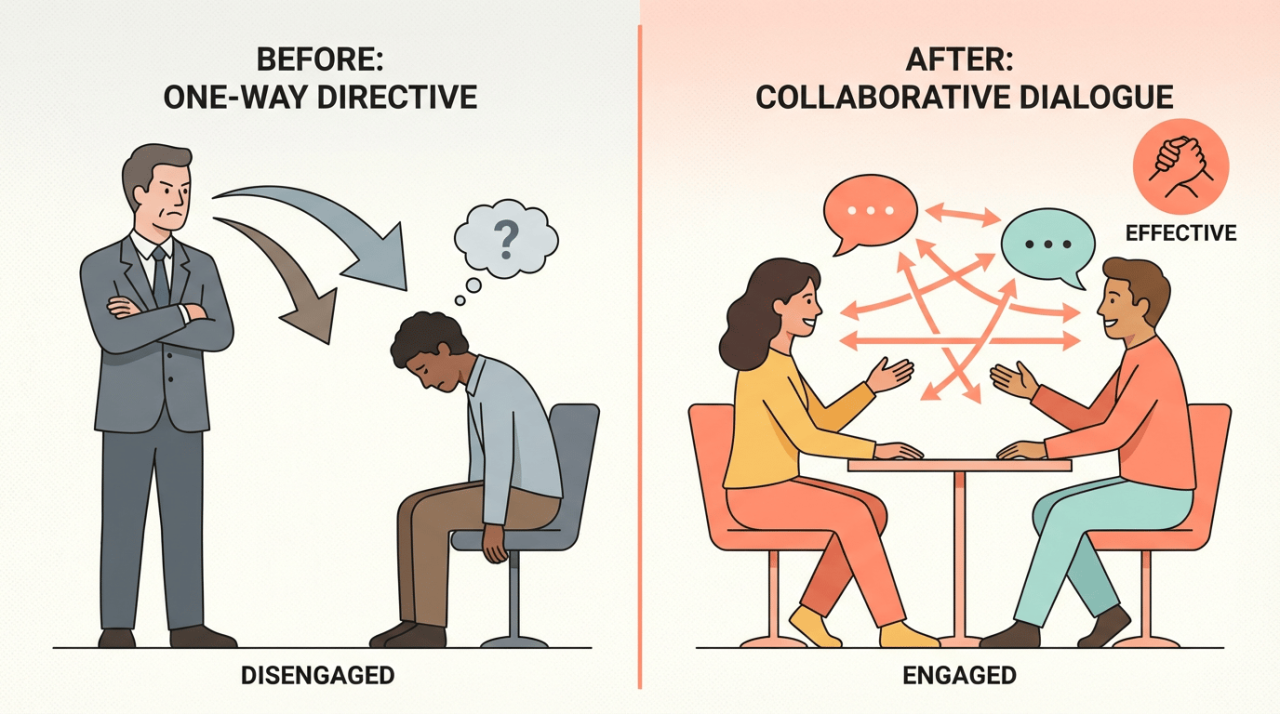
Second, avoid setting goals for them instead of with them. Co-creation leads to commitment, while dictation leads to compliance at best and resentment at worst.
Third, remember to follow up. Goals without accountability are just wishes, so you need to schedule regular check-ins to discuss progress, adjust as needed, and celebrate wins.
Fourth, don’t make it feel like a performance review. Goal-setting conversations should be forward-looking and supportive, not evaluative and judgmental. Save the formal performance feedback for designated review periods.
Making Goal-Setting Conversations a Habit
The best managers don’t treat goal setting as an annual or quarterly event. They make it part of their regular rhythm of leadership.
Try incorporating a few of these questions into your weekly or bi-weekly one-on-one meetings. Ask about progress, roadblocks, and alignment regularly.
When goal setting becomes a continuous conversation rather than a scheduled event, it loses its awkwardness and becomes a natural part of how you work together.
Ready to Level Up Your Leadership?
Are you a leader who’s been avoiding a difficult conversation? Want to learn how to have difficult conversations with confidence, skill, and emotional intelligence?
Our free guide gives you the exact framework, complete with scripts, checklists, and templates.
Download “The Leader’s Guide to Conversations That Drive Results” here: https://tr.ee/Z30PbI
Your Next Step
Here’s your challenge: Pick three questions from this post and use them in your next goal-setting conversation. Notice what happens when you ask them with genuine curiosity and listen carefully to the answers.
You might be surprised how much you learn, not just about your employee’s goals, but about what kind of support they need from you to be successful.
The quality of your questions shapes the quality of your conversations, and the quality of your conversations shapes the quality of your team’s performance.
Start asking better questions today.